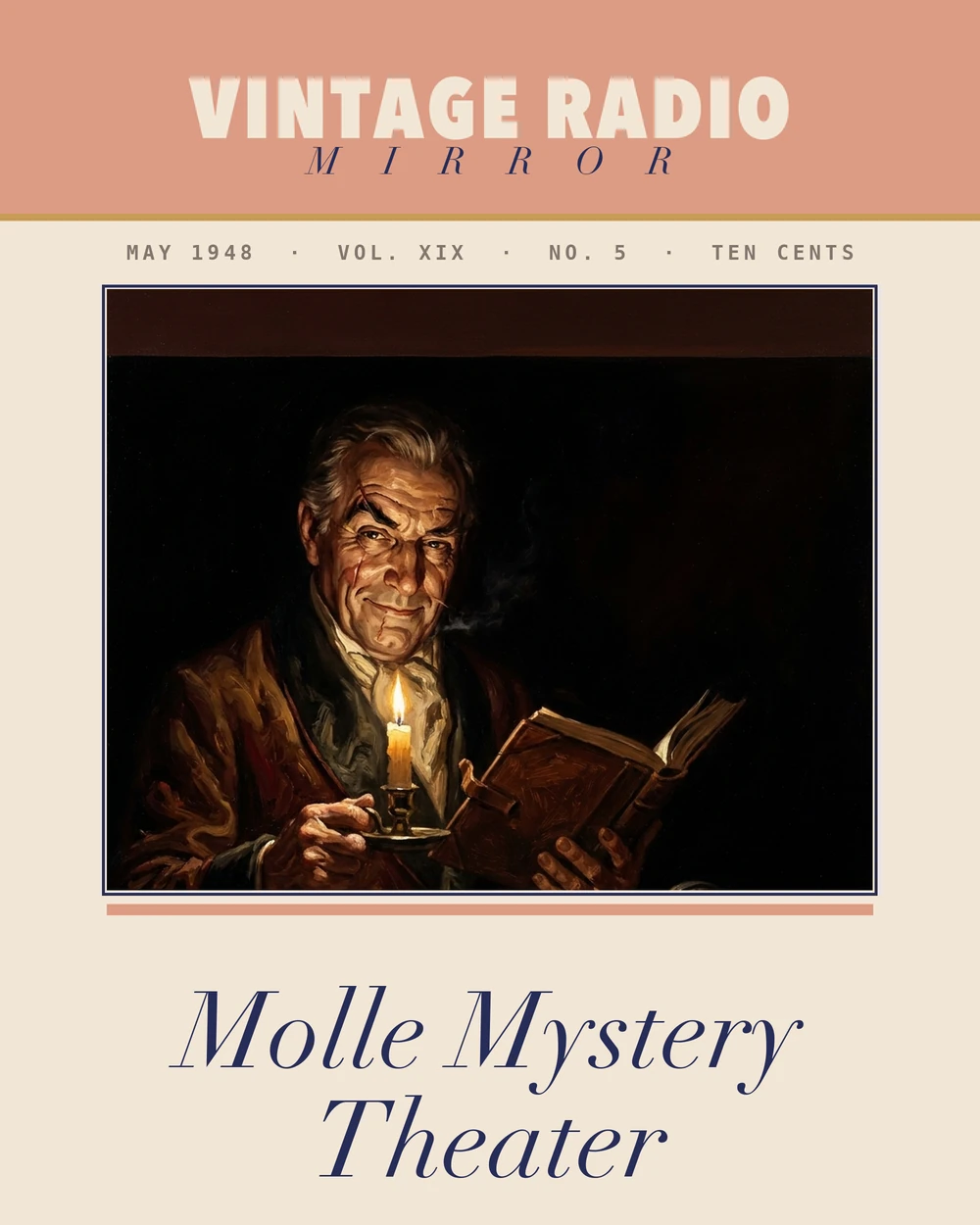
Molle Mystery Theater
The Show That Actually Delivered on Its Tagline
NBC launched Molle Mystery Theater on September 7, 1943, with a self-promotional tagline promising "a startling new series, featuring the world's most spine-tingling plays and stories." That kind of copy usually wrote checks the programs couldn't cash. Molle largely did cash them — at least through its NBC years, when the show adapted Raymond Chandler, Dashiell Hammett, Jonathan Latimer, Craig Rice, William Irish (Cornell Woolrich), Edgar Allan Poe, and Robert Louis Stevenson in successive weeks. The range was genuine. A Tuesday night in November 1943 could bring you Chandler's The Big Sleep; the following December, Lady in the Lake. By February 1944, Farewell, My Lovely had aired as well. Three Chandler novels in one season, alongside hard-boiled work from writers who were still actively publishing.
The product behind the show was Mollé brushless shaving cream — pronounced "moe-lay" — manufactured by Sterling Drugs, which came on as sponsor with Program #17, "The Mystery of the Seven Keys," on December 28, 1943. The first three months appear to have aired sustaining, suggesting NBC believed in the property enough to carry it while the commercial arrangements were worked out. Other Sterling Drug products, including Ironized Yeast, Energene, and Bayer Aspirin, also cycled through as sponsors during the NBC years.
What Made the NBC Years Work
The trademarks of the original NBC run were high tension and twist endings — endings often described as shocking. That combination, applied to source material drawn from the top tier of crime and literary fiction, gave the show a consistent quality that anthology mystery programs often struggled to maintain. It also helped that NBC promoted the series aggressively to newspapers, publicizing script titles, performers, and authors week by week. That documentation makes the NBC run one of the better-recorded anthology programs of the 1940s, with a clearer episode history than most of its contemporaries.
The on-air framing device was Geoffrey Barnes, a crime fiction connoisseur who introduced each week's story. The role was originated by an actor named Roc Rogers at the premiere, but Rogers quickly stepped aside, and Bernard Lenrow became the voice listeners associated with the part. Lenrow was born in Binghamton, New York, in 1903, studied drama at Cornell, and taught speech at Hunter College and the University of Iowa, where he also directed the Iowa State Players. He'd had his first radio audition in 1928 and committed to radio as a permanent career in 1936. The part suited him: Lenrow as Barnes was, by one contemporary account, "an avid connoisseur of mysteries since the 1920s" who "routinely read 100 mystery novels each year and personally selected the stories to be dramatized on Mystery Theatre." Whether that reflected reality or character biography, it was the right image for a show built on literary credibility.
The NBC cast drew from the working core of New York radio talent: Richard Widmark, Frank Lovejoy, Joseph Julian, Elspeth Eric, Anne Seymour, and Raymond Edward Johnson, who was simultaneously known as "Raymond," the host of Inner Sanctum Mysteries. Martin Gabel, George Petrie, Luis Van Rooten, Berry Kroeger, June Havoc, and Budd Collyer also appeared in supporting parts. Dan Seymour announced. Music was directed by Jack Miller. The show ran Tuesdays at 9 through July 3, 1945, took a break, then resumed on Fridays at 10 starting October 5, 1945, continuing in that slot through 1948. The NBC run comprised approximately 232 thirty-minute episodes.
The Armed Forces Connection
A notable secondary life for the NBC episodes came through the Armed Forces Radio Service, which rebroadcast a substantial portion of them on a program called Mystery Playhouse, running from roughly mid-1944 through mid-1946. The AFRS versions stripped out the original Mollé introductions, outros, and commercials. In their place, Peter Lorre recorded new introductions — tongue-in-cheek, with his greetings frequently opening "Hello... creeps." Episodes rebroadcast this way included adaptations of Jonathan Latimer's Lady in the Morgue, featuring the Bill Crane character, and "The Last Laugh Murder." The AFRS run gave the original NBC material a second audience of considerable size, reaching servicemen overseas who might never have heard the domestic broadcast.
When the Hummerts Took Over
When Molle Mystery Theater moved to CBS on June 29, 1948, the production changed hands and the show changed character. Frank and Anne Hummert took over, and the result tracked with what the Hummerts typically delivered: stilted dialogue, cardboard characters, and a melodramatic tone closer to Challenge of the Yukon than to a literary anthology. The sponsor shifted to Bayer Aspirin and Phillips Milk of Magnesia, still under the Sterling Drugs umbrella. The CBS version dropped the Mollé name from the title, broadcasting simply as Mystery Theater, though Geoffrey Barnes remained as host — a thread of continuity that linked it to the NBC original without really preserving what had made the original worth continuing.
Alfred Shirley played a new recurring character on the CBS run: Inspector Hearthstone of the Death Squad. Many of the same New York actors who had worked the NBC run turned up in supporting roles. But the anthology format of the NBC years gave way to the Hummerts' characteristic melodrama, and the show ran at CBS through June 19, 1951 — respectable in duration, diminished in quality.
The Spinoffs and the Long Tail
The CBS run generated two successor series, both produced by the Hummerts and both carrying diminishing returns. Hearthstone of the Death Squad spun off on CBS starting August 30, 1951, running thirty minutes at various times through September 17, 1952. The series was largely built from approximately thirteen original Hearthstone programs intermixed with repeats of earlier CBS Mystery Theatre episodes. By 1952, Hearthstone was being heard "virtually every day of the week — somewhere, usually in repeats," and CBS had evidently stopped promoting it. Inspector Hearthstone of the Death Squad left the airwaves on December 31, 1952.
Separately, a continuation known as both ABC Mystery Theater and Mark Sabre began on ABC on October 3, 1951, produced again by the Hummerts. Robert Carroll played Inspector Mark Sabre, with James Westerfield as Sergeant Maloney — though Westerfield was later replaced by Douglas Chandler and then Walter Burke as the series moved through seasons. For the second season, veteran radio actor Les Damon, known for The Adventures of the Falcon and The Thin Man, replaced Carroll in the lead. The ABC run aired Wednesdays at 8 from 1951 through 1953, then shifted to 9:30 for the final stretch, with Sterling Drugs again as sponsor. It ran 115 episodes before ending June 30, 1954.
Two days after the radio version launched on ABC, a parallel television program — Mark Saber Mystery Theater — premiered on ABC television, starring Tom Conway as Saber and James Burke as Sergeant Maloney. The TV version ran approximately 64 episodes through June 1954. The Mark Saber character later crossed the Atlantic as a British television series, The Vise (also known as Saber of London), produced by the Danzigers and starring Donald Gray, a real-life amputee, as a one-armed private detective in London. That series aired on ABC from 1955 to 1957 and then on NBC from 1957 to 1960. Whatever the Hummert-era radio versions lacked, the character proved durable enough to sustain a decade of television across two continents. Thrilling Detective notes, though, that there is "no direct connection whatsoever" between the NBC/CBS franchise and the ABC continuation — different network, different sponsor, different cast, different characters throughout.
What Survives
Of the approximately 232 NBC episodes, 73 are known to circulate — enough to get a clear sense of what the show was at its best. Bernard Lenrow's Geoffrey Barnes is well represented in that surviving material, and his performance drew consistent praise for its integration with the show's scripts and production values. Lenrow went on to play Commissioner Weston on The Shadow, Captain Bill Logan on Casey, Crime Photographer, and turned up on Suspense, Dimension X, X Minus One, You Are There, and Yours Truly, Johnny Dollar, among others. On Broadway he appeared in productions including Compulsion (1957–1958) and The Gang's All Here (1959–1960) before his death in Englewood, New Jersey, in October 1963.
The original NBC run remains the version worth knowing. The source material was serious, the cast was deep, and the anthology format let the writing breathe in ways the Hummert-produced successors never managed. A major network mystery anthology going directly to the best crime and literary fiction of its era, rather than working around it, was genuinely uncommon for commercial radio in 1943 — and the program's documented week-by-week promotion suggests NBC knew it had something worth tracking carefully.